

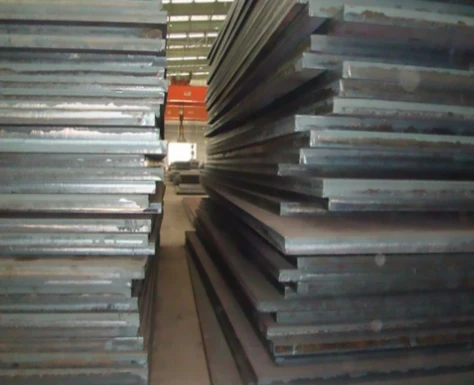
ASTM A387 Grade 11 is the entry grade of the chromium-molybdenum family that carries most refinery and power plant pressure equipment: roughly 1.25% chromium and 0.5% molybdenum on a carbon steel base, built to hold strength and resist hydrogen attack at temperatures where ordinary carbon plate would creep and embrittle. If your vessel drawing says "Cr-Mo, moderate temperature", Grade 11 is usually what it means. This page covers what buyers should check before ordering: the Class 1 / Class 2 split, heat treatment condition, the chemistry behind hydrogen resistance, and the fabrication steps - especially PWHT - that the mill must support for the certificate to be worth anything at inspection.
What A387 Grade 11 Actually Is
A387 is the ASTM pressure vessel plate specification for chromium-molybdenum alloy steel, and Grade 11 is its 1.25Cr-0.5Mo-Si member. The specification offers two strength classes: Class 1 (lower strength, supplied normalized or normalized and tempered) and Class 2 (higher strength, supplied normalized and tempered, or quenched and tempered by agreement). The alloy does two jobs: chromium forms stable carbides that resist hydrogen attack and graphitisation, and molybdenum raises creep strength so the plate holds its yield at sustained temperatures up to about 540 degrees Celsius. That combination is why Grade 11 shows up in hydroprocessing units, heat exchanger shells, boiler drums and reactor internals - anywhere hydrogen and heat arrive together. For room-temperature and sub-creep duty, plain carbon plate such as our ASTM A516 Grade 70 steel plate is the cheaper and correct choice; Grade 11 earns its premium only above roughly 350 degrees Celsius service.
Chemistry and Mechanical Properties
| Item | A387 Gr 11 typical requirement | Buyer note |
|---|---|---|
| Carbon (C) | 0.15% max (ladle, Class dependent) | Weldable with Cr-Mo filler, preheat normally required above 20 mm |
| Chromium (Cr) | 1.00 - 1.50% | Hydrogen attack and graphitisation resistance |
| Molybdenum (Mo) | 0.45 - 0.65% | Creep strength at sustained temperature |
| Silicon (Si) | 0.50 - 1.00% (Class dependent) | Deoxidation control per the specification table |
| Yield, Class 1 | 255 MPa min (t ≤ 25 mm) | Drops with thickness - quote the exact gauge |
| Yield, Class 2 | 310 MPa min (t ≤ 25 mm) | Normalized + tempered delivery |
| Tensile, Class 2 | 515 - 690 MPa | Class 1 band is lower; certificates state tested values |
Table note: requirements per ASTM A387/A387M for the thin plate band; heavier sections carry reduced minimums and the certificate states the tested heat values.
Class 1 vs Class 2: Decide Before the RFQ
The class is not a quality level - it is a strength and heat treatment combination. Class 1 ships normalized (or normalized and tempered) with the lower yield band; Class 2 ships normalized and tempered and carries roughly 55 MPa more yield at the same thickness. Fabricators like Class 2 for thinner shells because vessel design pressure falls out of the yield; shops with heavy PWHT schedules sometimes prefer Class 1 because tempering behaviour is more forgiving. The mistake to avoid is ordering "A387 Gr11" bare - the mill will pick a class for you, and vessel code calculations pinned to the wrong class fail U-stamp review. State class, heat treatment condition and expected PWHT temperature together with the RFQ, and we confirm the mill's process window before production.
Sizes and Delivery Condition
| Dimension | Typical range | Notes for buyers |
|---|---|---|
| Thickness | 6 - 150 mm | Above 100 mm usually runs mill production, allow 3-5 weeks |
| Width | 1500 - 4020 mm | Shell rings nested from the cutting plan save welds |
| Length | up to 14000 mm | Oversize plates ship flatbed or breakbulk |
| Condition | normalized; N+T; Q+T by agreement | Simulated PWHT coupons available for code vessels |
Table note: routine mill ranges; ultrasonic testing to ASTM A578 and Z-test packages can be added against project specification.
Fabrication Notes Buyers Should Plan For
Three items decide whether a Gr11 order runs clean at fabrication. First, welding: use matching Cr-Mo filler (E8015-B2 class), preheat in the 150-200 degree band for normal thicknesses, and interpass control - the plate welds fine, but carbon steel procedures do not transfer. Second, PWHT: code vessels in Cr-Mo require stress relief around 620-650 degrees Celsius, and the mill should supply material heat-treated to tolerate it - ask for simulated PWHT mechanical coupons when the vessel code demands them, because tested-as-delivered values drift after fabrication heat treatment. Third, hardness control after PWHT for hydrogen service: keep the HAZ within the NACE-recommended band, which is a fabrication discipline the plate certificate only enables. The high-temperature piping that connects to these vessels is a separate specification - see our ASTM A106 seamless carbon steel pipe page for the carbon side of the loop.
Grade 11 vs Grade 22 vs 16Mo3
Choose by temperature and hydrogen duty. Grade 11 covers moderate Cr-Mo service - exchanger shells, moderate-temperature drums - and is the most cost-efficient member of the family. When design temperature pushes toward 550-600 degrees or the unit is a hydrocracker with severe hydrogen duty, move up to ASTM A387 Grade 22 (2.25Cr-1Mo). When the drawing follows EN 10028-2 with a molybdenum-only alloy up to about 480 degrees, the answer is 16Mo3, which welds more simply than either Cr-Mo grade. If you are mapping equivalents across standards for a mixed-spec project, send the drawing to us through the contact page and we will confirm the grade, class and heat treatment condition against the governing code before quoting.
Frequently Asked Questions
What is the difference between A387 Grade 11 Class 1 and Class 2?
Strength and heat treatment, not quality. Class 1 is normalized (or N+T) with 255 MPa minimum yield in thin plate; Class 2 is normalized and tempered with 310 MPa. Quote the class your vessel code calculation assumes.
Do you supply simulated PWHT test coupons?
Yes. For code vessels we supply coupons heat-treated at the fabrication PWHT cycle (or longer, per the code), so the mechanical values on file match the material as it enters service. State the PWHT temperature and hold time with the RFQ.
What certificates come with Grade 11 plate?
EN 10204 3.1 MTCs per heat with full chemistry and mechanical tests, heat numbers stencilled on plates. Impact testing, UT to ASTM A578 and third-party inspection (SGS, BV, TUV) can be added to the order.
Can you cut shell rings and nozzles from plate?
Yes - flame, plasma and laser cutting with nesting against your drawing, plus bevelling for weld prep. Send the cutting plan with the RFQ; mill nesting wastes less material than shop cutting.
Hot Tags: astm a387 grade 11 steel plate, a387 gr11 alloy steel plate, a387 grade 11 class 2, chromium molybdenum steel plate, a387 gr11 China supplier, alloy steel plate price


