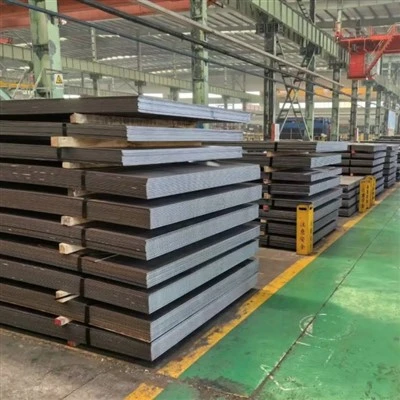
Both are 70,000 psi-class steels, and both are routinely available in the same thickness range from Chinese mills. That is where the similarity ends.
ASTM A516 Grade 70 is a pressure vessel plate. ASTM A572 Grade 50 is a high-strength low-alloy structural plate. They differ in yield strength, chemistry, toughness testing and weldability - and substituting one for the other, in either direction, is a code violation rather than a commercial shortcut.
Comparison Table
| Property | ASTM A516 Grade 70 | ASTM A572 Grade 50 |
|---|---|---|
| Primary use | Pressure vessels, boilers, storage tanks | Structural steel - bridges, buildings, towers, equipment frames |
| Tensile strength | 70 – 90 ksi (485 – 620 MPa) | 65 ksi min (450 MPa) |
| Yield strength | 38 ksi min (260 MPa) | 50 ksi min (345 MPa) |
| Carbon, max | 0.31% (ladle), 0.28% for thickness > 50 mm | 0.23% |
| Manganese | 0.85 – 1.20% | 1.35% max |
| Grain practice | Fine grain required (aluminium-treated) | Not specified |
| Impact testing | Not mandatory in base spec; supplementary S1–S5 available | Not required |
| Thickness range | 5 – 300 mm | Up to 100 mm typical |
| Weldability (CE) | Moderate; preheat often required above 25 mm | Good; lower carbon, easier field welding |
| Relative price | +10–20% | Baseline |
Why A516 Gr 70 Costs More
Three requirements drive the premium:
1. Fine grain practice is mandatory
A516 requires the steel to be fully killed and aluminium-treated, producing a fine austenitic grain size. This improves notch toughness - the ability to resist brittle fracture - which is the governing concern in a pressure vessel. A572 imposes no grain-size requirement.
2. Impact testing is available and often specified
The base A516 specification does not mandate Charpy testing, but the supplementary requirements (S1 through S5) provide for impact tests at specified temperatures for thicknesses above 38 mm, or at the purchaser's option. Vessels in low-temperature service, and anything governed by ASME Section VIII Div. 1, will require them. A572 has no equivalent provision.
3. Chemistry is controlled for pressure containment
Carbon is capped and manganese is banded to balance strength against toughness and weldability. A572 Grade 50 is designed around a different trade-off: reach 50 ksi yield economically, with carbon kept low (0.23% max) for weldability in field conditions, using micro-alloying (niobium, vanadium) rather than carbon for strength.
The Consequence of Substituting
| Substitution | What happens | Verdict |
|---|---|---|
| A572 Gr 50 substituted for A516 Gr 70 | Yield is higher (50 vs 38 ksi), but toughness is unqualified, no fine grain requirement, no impact test basis. ASME VIII will not accept it without a full material qualification. | Not permitted for code-stamped vessels |
| A516 Gr 70 substituted for A572 Gr 50 | Mechanically adequate - yield 38 vs 50 ksi required, so under-strength. Would need a section-thickness recalculation. Costs more and still fails the strength check. | Not permitted without redesign |
The counter-intuitive point: A572 Gr 50 has the higher yield strength (50 vs 38 ksi), which is why buyers sometimes assume it is the "better" plate. For a pressure vessel, higher yield with unqualified toughness is a liability, not an upgrade - the failure mode shifts from ductile bulging to brittle fracture.
How to Specify Correctly
For a pressure vessel
State: "ASTM A516 Grade 70, normalized, fine grain, impact tested at −20°C, 27 J minimum, to ASME Section II Part A." If the vessel operates below 0°C, the impact test temperature is not optional.
Note the delivery condition. A516 is available as-rolled, normalized, or normalized and tempered. Above 40 mm, normalization is typically required to maintain toughness. Specifying "A516 Gr 70" without a condition leaves the mill free to supply as-rolled.
For a structure
State: "ASTM A572 Grade 50, thickness X mm, to ASTM A6 tolerances." Add Charpy requirements only where the structure is dynamically loaded or in cold climate - for bridges in low-temperature regions, A709 or A572 with CVN is the correct specification.
Where Q345 / S355 fit
For overseas projects specifying Chinese or European grades, Q345 and S355JR are the structural equivalents of A572 Gr 50. They are not substitutes for A516 - China's pressure vessel grade is Q245R / Q345R under GB 713, which maps more closely to A516.
Delivery and Inspection Notes for Importers
- Thickness tolerance matters more on plate than pipe. A516 is ordered to ASME/ASTM A20 tolerances; A572 to A6. Confirm which tolerance applies, because the permitted minus deviation directly affects the pressure calculation.
- UT inspection is often specified for vessel plate. Specify the acceptance level (e.g. ASME VIII Div. 1 Appendix 12, or ASTM A578 Level II) at the quotation stage.
- Cut-to-size adds lead time. Plate is normally supplied in 2000 × 6000 mm or 2500 × 12000 mm. Custom sizes need 7–10 extra days.
- MTC must show heat number, chemistry, tensile, yield, elongation and the heat treatment condition. For A516, the fine-grain aluminium content should appear.
Frequently Asked Questions
Is A572 Grade 50 stronger than A516 Grade 70?
In yield strength, yes - 50 ksi versus 38 ksi. In tensile strength, no - A572 Gr 50 requires 65 ksi minimum, A516 Gr 70 requires 70–90 ksi. They are optimised for different failure modes.
Can A516 Gr 70 be used for structural work?
It can, and it will usually be over-specified and more expensive. The exception is where toughness matters more than strength - cold-climate structures, dynamically loaded connections.
What is the difference between A516 Gr 70 and A516 Gr 70N?
The "N" denotes normalized delivery. Normalizing refines grain structure and improves toughness, and is normally required above 40 mm thickness or for low-temperature service.
Does A516 Gr 70 need impact testing?
Not under the base specification. It becomes mandatory when the governing code requires it - typically ASME Section VIII for vessels below a certain temperature, or when the purchaser invokes supplementary requirement S1–S5.
What is the price difference?
A516 Gr 70 typically carries a 10–20% premium over A572 Gr 50 at the same thickness, and the gap widens when impact testing and UT inspection are added.
Pressure Vessel and Structural Plate Supply
Henry Steel supplies ASTM A516 Grade 70 steel plate from 8 to 300 mm in as-rolled, normalized and normalized-plus-tempered condition, with impact testing and UT inspection to your specified level, and ASTM A572 Grade 50 plate for structural projects, both with cut-to-size service and full mill traceability.
Browse carbon steel plate by grade → or send your plate specification for pricing and lead time.