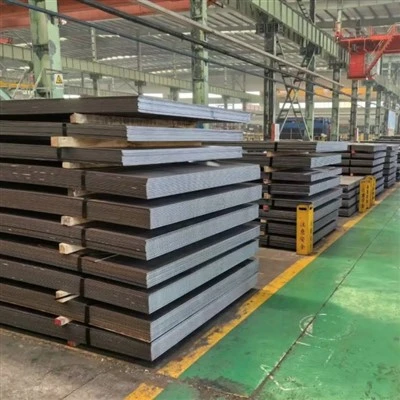
The choice between hot rolled and cold rolled plate is decided by two numbers - thickness and tolerance - and confirmed by a third, price. Everything else follows from how the plate was made.
Both start as the same steel. The difference is whether the final reduction happens above or below the recrystallisation temperature, and that single fact sets the achievable thickness, the surface, the mechanical properties and the cost.
The Process Difference In One Paragraph Each
Hot rolling takes a reheated slab at around 1,100–1,250°C and reduces it through a series of rolls while the steel is still above its recrystallisation temperature - roughly 900°C. Because the metal recrystallises as it deforms, no work hardening accumulates, and the mill can take large reductions in a single pass. The result is a plate with a fine, uniform grain structure, an oxide scale on the surface, and a thickness range that starts around 1.5 mm and runs past 25 mm into heavy plate.
Cold rolling takes hot rolled coil, pickles off the scale, and reduces it at room temperature. The steel work hardens as it thins, so the reduction has to be spread over several passes with an annealing step - batch annealing at 600–700°C or continuous annealing at higher temperature - to restore ductility. That extra rolling and the annealing are what the price premium pays for. Cold rolled thickness typically runs 0.15–3.0 mm.
Side-By-Side Comparison
| Factor | Hot rolled | Cold rolled |
|---|---|---|
| Rolling temperature | Above recrystallisation, ~900°C+ | Room temperature |
| Thickness range | 1.5 – 25 mm sheet; plate to 200 mm | 0.15 – 3.0 mm |
| Thickness tolerance | Looser; typically ±0.1–0.3 mm depending on width | Tight; typically ±0.02–0.05 mm |
| Surface | Mill scale; pickled and oiled optional | Smooth, bright, no scale |
| Flatness | Good, with some crown and edge wave | Excellent |
| Mechanical properties | Softer, higher elongation | Work hardened; higher yield, lower elongation, unless annealed |
| Internal stress | Low | Residual stress from rolling unless stress-relieved |
| Cost per tonne | Base | 15 – 40% higher |
| Minimum order practicality | Flexible, wide size range | Limited to thin gauges and standard widths |
What The Tolerance Number Means In Production
On a laser-cut part, tolerance decides whether the job runs. A 3 mm hot rolled plate carries a tolerance around ±0.15–0.3 mm, so the actual thickness across a sheet can vary by up to 0.6 mm. For a bracket that is fine. For a stamped component that must fit a mating part to 0.1 mm, it is not.
Cold rolled holds ±0.02–0.05 mm across the coil, which is why it dominates wherever the part is formed, stamped or assembled without further machining. The premium buys predictability, not strength.
Mechanical Properties: The Annealing Question
Cold rolling work hardens the steel. In the full-hard condition, yield strength can be double that of the annealed hot rolled product, with elongation falling to single figures. That is useful where stiffness matters and forming does not.
Once annealed, cold rolled sheet recovers properties close to hot rolled - the same grade designation (Q235B, SPCC, DC01) will show similar tensile results. So "cold rolled is stronger" is only true for the unannealed condition. If the drawing needs strength, specify the temper, not the process.
Two practical consequences:
- Bending radius. Full-hard cold rolled cracks at tight radii. Annealed material bends like hot rolled. The bend radius on the drawing should match the temper supplied.
- Weldability. Both are carbon steel and weld conventionally, but cold rolled sheet with residual stress can distort more after welding, because the stresses release as heat is applied.
Where Each One Belongs
Hot rolled for anything structural or heavy: shipbuilding, pressure vessels, bridge and building structures, heavy machinery frames, storage tanks, and any part above 3 mm wall. It is also the correct choice where the surface will be machined or painted anyway, because paying for a smooth finish that gets removed is waste.
Cold rolled for thin, precise, visible or formed parts: automotive panels, appliance housings, furniture, electrical enclosures, HVAC components, and anything that will be deep drawn or coated with a decorative finish.
A common hybrid: hot rolled for structure, cold rolled for the visible skin. This is normal and usually cheaper than making everything from one grade.
Cost: Why The Premium Varies
Cold rolled costs more because of the extra processing - pickling, multi-pass rolling, annealing, temper rolling, and the yield loss from edge trimming. The premium moves between 15% and 40% depending on thickness and width: thin wide coil carries the highest premium because the rolling and annealing cost is spread over fewer tonnes.
That is also why the comparison should be made on finished-part cost rather than on price per tonne. If cold rolled removes a machining step or cuts scrap from tolerance rejects, the higher price per tonne often loses on total cost - and if it does not, hot rolled wins.
Frequently Asked Questions
Can hot rolled plate be substituted for cold rolled?
Only where the tolerance and surface are not functional. Above 3 mm the substitution is usually impossible anyway, because cold rolled is not produced that thick.
What does "pickled and oiled" mean?
The hot rolled surface scale is removed by acid pickling and the sheet is oiled to prevent rust during transport. It gives a clean, weldable surface at a fraction of the cold rolled price, and is the usual choice when scale must go but tolerance does not need to be tight.
Is cold rolled steel stronger?
In the full-hard condition, yes - yield strength can be close to double. After annealing, the two are comparable. Strength comes from the temper and the grade, not from the rolling process name.
Which one rusts faster?
Both rust at the same rate for the same grade and exposure. Cold rolled looks cleaner because it starts without scale, but it has no corrosion protection either - an oil film is the only barrier on both.
Ordering Steel Plate
We supply hot rolled steel plate from 1.5 mm to 200 mm and cold rolled carbon steel plate from 0.15 mm to 3.0 mm, in Q235B, Q355B, SS400, S235JR and ASTM A36, with mill certificates.
Send the grade, thickness, width and the tolerance that actually matters to the part - not the catalogue tolerance - and we will quote the process that meets it. The full range is on our carbon steel plate page.
Send your plate specification for a quotation - we reply with price per tonne, tolerance confirmation and delivery schedule.