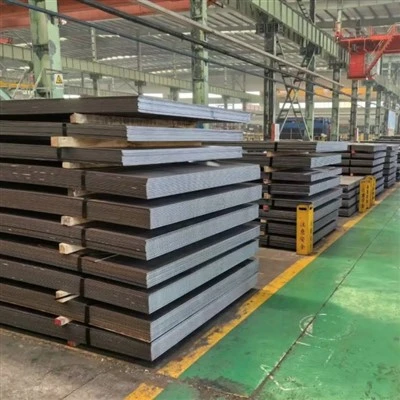
The U-shaped sheet pile is the default retaining structure for cofferdams, quay walls and flood defences because its interlock carries the load transfer between piles, not the soil. Getting the interlock type and grade right matters more than the section modulus.
This guide covers how the U profile behaves under load, the grades that are actually stocked, and the selection sequence engineers use when a retaining wall has to be both safe and buildable.
How The U Profile Works
A U-type pile is a hot-rolled channel formed with a claw on one edge and a finger on the other. When the next pile is threaded in, the finger enters the claw and forms a continuous joint running the full length of the wall. That joint does two things at once: it seals the wall against soil and water passage, and it transfers shear between adjacent piles so the wall acts as a diaphragm rather than a row of independent beams.
The profile is driven with the web facing alternate directions - a "U" then an inverted "U" - so the wall presents a corrugated face. This alternation is what gives the section its high second moment of area about the axis parallel to the wall: material is pushed away from the neutral axis, so a 10 mm thick section can develop the same bending capacity as a much heavier flat plate.
Two interlocks exist in practice. The Larssen interlock is the original asymmetric claw-and-finger joint, still the most common globally. The P-P interlock is symmetric and allows the piles to be threaded from either direction, which speeds up handling on site at the cost of slightly lower joint strength. Both are watertight to a degree, but neither is a certified water barrier - where seepage must be controlled, a sealant in the interlock or a separate waterproofing detail is required.
Grades And Mechanical Properties
Sheet pile grades are defined by minimum yield strength, and the difference between them is what allows a lighter section to carry the same bending moment. The two families that appear on most international orders are EN 10248 and the Chinese GB series:
| Standard | Grade | Min yield ReH (MPa) | Tensile Rm (MPa) | Typical use |
|---|---|---|---|---|
| EN 10248-1 | S240GP | 240 | 340 – 440 | Light retaining walls, short term works |
| EN 10248-1 | S270GP | 270 | 360 – 460 | General cofferdams and trench support |
| EN 10248-1 | S320GP | 320 | 400 – 500 | Permanent retaining structures |
| EN 10248-1 | S355GP | 355 | 440 – 540 | Quay walls, deep excavation, marine |
| EN 10248-1 | S390GP | 390 | 470 – 570 | Heavy marine and berth structures |
| EN 10248-1 | S430GP | 430 | 510 – 610 | Highest load cases, thick sections |
| GB/T 20933 | SY295 | 295 | 440 min | Domestic Chinese projects, general works |
| GB/T 20933 | SY390 | 390 | 540 min | Marine and heavy temporary works |
| GB/T 700 | Q235B | 235 | 370 – 500 | Low-cost temporary works |
| GB/T 1591 | Q345B | 345 | 470 – 630 | Equivalent role to S355GP |
Note that EN grades specify a tensile range, while the GB grades specify a minimum only. On a project where the client's engineer has designed to EN 10248, substituting Q345B for S355GP changes the ductility assumption even though the yield matches. Substitution should be put to the designer, not decided at the mill.
U Versus Z Profile
Both profiles are rolled from the same steel and both use interlocks. The choice is usually driven by wall geometry rather than strength:
| Factor | U-type | Z-type |
|---|---|---|
| Neutral axis position | Outside the section, at the interlock | Within the section, near the web centre |
| Effective section modulus | Lower than single-pile value, because the joint slips | Close to single-pile value |
| Interlock tensile capacity | Lower - the joint is in the tension zone | Higher - the joint sits near the neutral axis |
| Driving behaviour | Self-guiding, tolerant of deviation | Needs more guidance in hard ground |
| Typical use | Cofferdams, trench sheeting, short walls | Deep walls, marine structures, high bending |
The practical consequence: for walls above roughly 8–10 m of retained height, the Z profile usually wins on steel weight, while the U profile remains cheaper and faster for temporary works where driving tolerance matters more than section efficiency.
Selecting A Section
Selection runs in four steps, and skipping the second is the most common cause of a wall that deflects more than predicted:
- Determine the bending moment from the retained height, soil parameters, surcharge and water pressure, using the chosen design method (limit equilibrium or finite element).
- Reduce the single-pile section modulus to an effective value. For U piles the reduction is typically 20–40% depending on interlock slip, and it must be applied before selecting a section.
- Check interlock capacity against the tensile force at the joint, particularly where the wall acts as an anchor curtain or carries uplift.
- Check driveability - section thickness against soil N-value, and the hammer energy available. A section that cannot be driven to depth is not a section.
Lengths, Delivery And Handling
Standard lengths run from 6 m to 24 m; anything above 24 m is normally spliced on site with a welded butt joint and a backing plate, because transport becomes the constraint long before rolling does. Piles are shipped in bundles of 5–10 pieces, and the bundle weight - not the individual pile weight - governs crane capacity and container loading.
Two delivery details decide whether the wall goes in cleanly:
- Interlock protection. Claws and fingers are easily deformed in handling. Deformed interlocks jam during driving and cannot be freed without extracting the pile. Bundles should be lifted with slings at the marked positions, never by the interlock.
- End finish. Piles driven into gravel or weathered rock need a cutting shoe or a reinforced toe. Specify it at order stage; it cannot be added economically on site.
Frequently Asked Questions
What is the difference between U-type and Larssen sheet piles?
Larssen is the name of the interlock geometry most U-type piles use, derived from the original Larssen profile. In practice "Larssen pile" and "U-type pile" are used interchangeably, though technically Larssen refers to the joint rather than the section shape.
Which grade should I use for a permanent marine wall?
S355GP or S390GP to EN 10248-1 is the common specification. Marine walls add a corrosion allowance on the exposed face, typically 1–2 mm depending on the design life and whether cathodic protection or a coating system is used.
Are U-type sheet piles watertight?
No. The interlock reduces seepage but is not a water barrier. Where a dry excavation is required, the design normally adds interlock sealant, a filter and pumping allowance, or a separate cut-off.
Can sheet piles be extracted and reused?
Yes, and for temporary works this is often the commercial basis of the project. Reuse requires the interlocks to be undamaged and the piles to be straightened; a pile extracted with a deformed claw is scrap.
Ordering U-Shaped Sheet Piles
We roll U-shaped steel sheet piles in S240GP through S430GP and SY295/SY390, in lengths up to 24 m, with cutting shoes and corner sections to match the wall layout. Send the section, grade, length and total wall area and we will confirm the driving plan and delivery schedule.
For the wider product family, including Z-shaped sheet piles for deeper walls, see our steel sheet pile range. Background on section types is also covered in our sheet pile types note.
Send your wall drawing for a section and price proposal - we reply with a recommended section, steel weight per square metre of wall and a loading plan.